Showing posts with label autumn. Show all posts

Monday, October 28, 2024

From My Nature Journal: A Walk in the Woods and a Missing Piece in Christian Discipleship

I was fortunate last week to serve as program director of a week-long retreat experience for pastors in our denomination, a retreat we call “Deeper in Christ.” Intended for our clergy in a season of discernment, in need of rest, or simply looking for quality, guided quiet time with God, we do a couple of these a year through the generosity of the Lilly Foundation, and our venue this time was one of our favorites, St. John’s University and Abbey in Collegeville, Minnesota. We had a great week together.

New England has nothing up on Central Minnesota this time of year, and the fall colors were spectacular, even deepening over the several days we were there. In such a setting, and with the warm and inviting weather we experienced, we urged retreatants and staff alike to get out and enjoy the sanctuary of God’s creation every opportunity they could. St. Johns’ property includes vast hardwood and coniferous forests, oak savanna, prairies, wetlands (some complete with boardwalks for up-close inquiry), and gorgeous riparian habitat around a large northwoods lake. Trails completely traverse the property, and one can walk or hike numerous routes without ever stepping foot on the same terrain twice. Wildlife abounds -- deer, squirrels, raccoons, eagles, great blue herons, and songbirds and waterfowl of many kinds. I even nearly stumbled upon a small black bear shortly after dusk one evening. I must say that I always enjoy seeing a bear on a trail, but especially when it is running away from me rather than towards me. 

Benedictine hospitality is also stellar, what with their rule of receiving guests as one would receive Christ. It is one of the things that make this location one of the top three or four retreat centers in our rotation. Even the architecture of the guesthouse takes full advantage of the natural beauty, with large picture windows, patios and terraces overlooking woods and water views. Fall color? In various coniferous greens along with the deciduous reds, yellows, oranges and golds of the hardwoods, it is truly a varied palette. And the trees? There are red and white pine, even some jack, red and sugar maple, white birch, poplar, cottonwood, red and white oak, black and blue spruce, hemlock, ironwood, balsam fir, tamarack, eastern white cedar and willow, let alone many smaller species -- but just as colorful an assortment – such as dogwood, alder and a nearly breathtaking sumac. 

One late afternoon, several of us staff went out to walk a trail together before the dinner hour. We all were smitten by beauty upon beauty as we navigated the trail up and down through its varying topography, and my dear friend and sister in Christ Debbie turns to me and says, “Rick, how is it that we appreciate so much the beautiful diversity of a forest and yet struggle so much in our culture to appreciate and see the beauty of human diversity?” Debbie has been a respected leader for many years in our denomination in the area of Christian formation, and one of her many specialties has been justice ministries as we have worked to pursue a missing piece of evangelical discipleship, that of racial righteousness and reconciliation. An African-American, she recruited me many years ago to help resource this important work among our pastors and churches, and it has been one of the most meaningful labors of my career, and Debbie one of my most beloved mentors. She continued, “I sit on the guesthouse deck or in my room and treasure the beauty of diversity displayed before my eyes, and I ask, ‘Why? Why is it so hard in the human realm?’”

What an important question. Why indeed? 

There’s no question as to whether nature thrives in diversity. It always has. Even in cultivated settings, a large rose garden of the same hue of red hardly captures the beauty of one with a variety of colors. In fact any garden with all the same flower, say, yellow lilies, scarcely captures the senses like a garden with varying textures, colors, sizes and shapes. Even a basket of mixed fruits portrays a greater attraction than a bowl of green grapes. And then I think about farming practices and what we call our economies of scale that result in vast monocultures, whether Midwestern corn or overseas palm oil plantations. These all end up requiring pesticides and fertilizing chemicals to replenish the soil with what would be produced naturally if the culture were more diverse. Now I can’t go far on this subject because I know very little about farming, but the point is made. Nature thrives in diversity.

...How is it that we appreciate so much the beautiful diversity

of a forest and yet struggle so much in our culture to 

appreciate and see the beauty of human diversity?

Yet forests and gardens and farming are one thing. Cultural diversity is completely another. The challenges of forestry and agriculture, though very important in the realm of creation care (another oft-missed piece in Christian discipleship), usually seem infinitely simpler than the racial challenges we face. And yet the reason I write this blog is because I find, again and again, that nature has very important things to teach us, and that what it teaches is confirmed over and over in the Bible. God’s word could not be clearer than it is on the beauty of the human family -- all people -- created in God’s very image. 

So it’s still early enough in the fall that there is a LOT of color out there. What are called ‘leafers’ or ‘leaf-peepers’ are out in droves, as usual, whether visiting the beauty of the northeast or northwoods, the aspen golds of Colorado, the diverse majesty of the Appalachians, or the western larch’s flaming yellows in the Northern Rockies. Do this for me: next time you’re appreciating fall color somewhere, say a prayer of appreciation for human diversity and for a personal commitment to racial reconciliation, a critically missing piece in Christian discipleship. Then act on that prayer.

Get outside.

~~ RGM, October 17, 2024


Friday, November 25, 2022

From My Nature Journal: Rejoicing at God’s Wonders


Three weeks ago today, Gail and I had the ‘blessing’ of the season’s very first snowfall while battening down the hatches to abandon for the winter our little cabin in Michigan’s Upper Peninsula woods. I use quotations because that blessing certainly can be mixed, as it was this year. Whenever we stay through to the last half of October we often will experience the first snow, but it typically comes in flurries or a good dusting, coating the conifers with a crystalline beauty that takes breath away. Not this year. It was a bona fide storm, thrilling for our visiting grandchildren on fall break from school; after snowmen and snow angels, they even got to eat dinner and go to bed during an end of the day power outage, which made it feel like a true Little House in The Big Woods experience for them. But six inches of snow did indeed put the permanent parking brake on the fall raking yet to be completed, and just served to complicate the closing in general. Still, it was better than the blizzard during which we left several years ago. That one made loading the car a real treat.

I admit the result of the storm was beautiful, though. It had been a gorgeous fall in full color. Many trees were still holding on to some of that, so the mixture of the pristine white with all the reds, golds, oranges and forest greens made one’s heart sing. But very warm days leading up to that pre-winter weather event left a lot of warmth in the ground, especially the gravel roads; so though the woods and yards were a thick snowy blanket, the road was wet but relatively clear. 

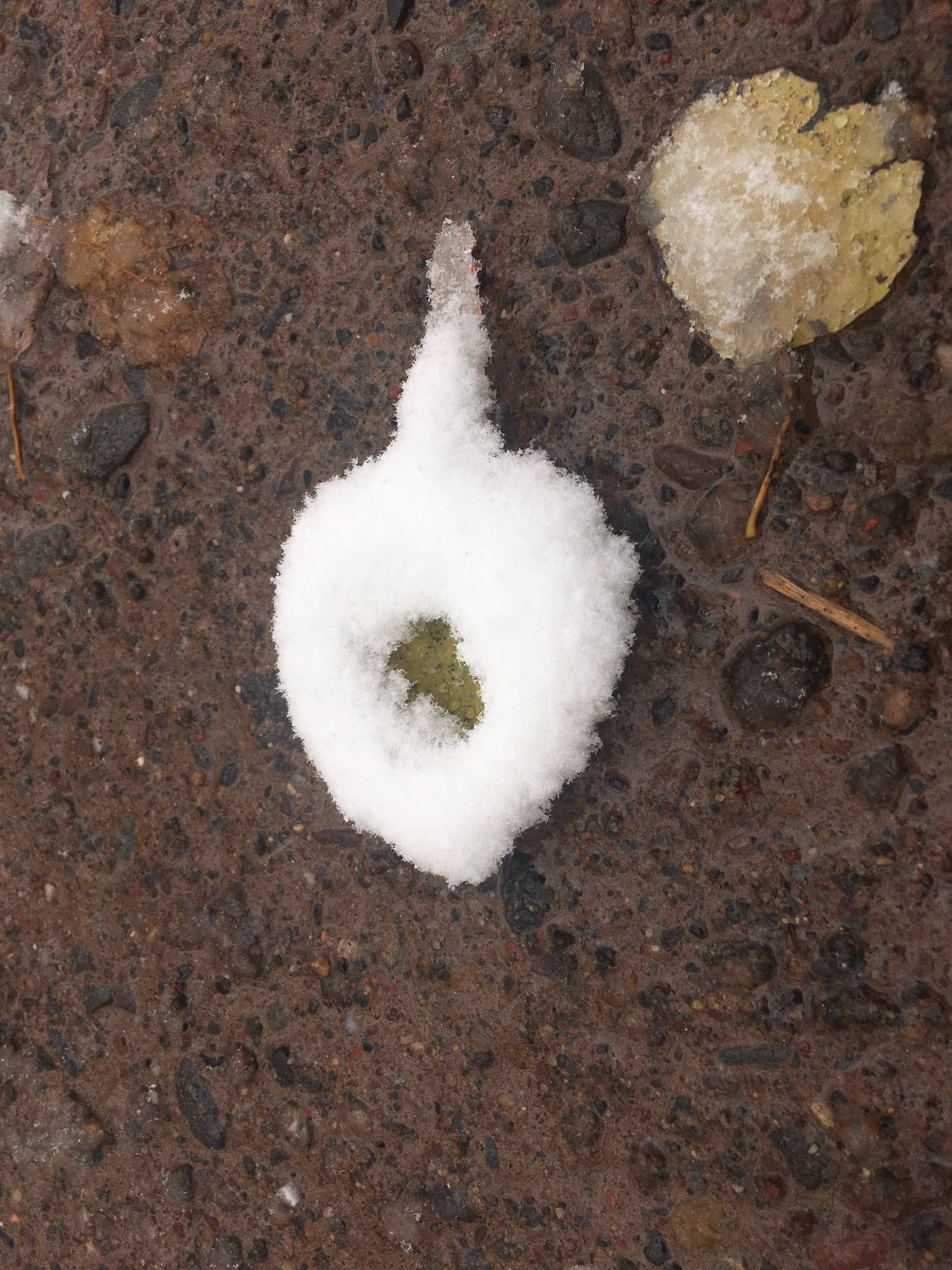
About halfway through the snowfall I went out for a walk on that road and discovered dozens of these magnificent little snow sculptures where leaves had fallen. You may identify the maples easily. How did you do with the birch and large tooth aspen? In all my comings and goings over the years, I did not recall seeing anything like it before. The conditions must have been just perfect for it, and it reminded me how often a naturalist sees things they’ve never seen before nor ever may again. I love that part of being a nature observer, but it always takes me a little by surprise. (Continued below photos.)


The Northumbria Community of the U.K. has a lovely blessing that is part of the morning liturgy in their book Celtic Daily Prayer, a prayer blessing I have loved for years and offered over many. It goes like this:

May the peace of the Lord Christ go with you wherever he may send you.

May he guide you through the wilderness, protect you through the storm.

May he bring you home rejoicing at the wonders he has shown you.

May he bring you home rejoicing once again into our (or his) doors.

The wonders God has shown me… I see them every day, large and small. I hope you do as well. They’re out there. I am grateful. 

Gitcha some outdoors.

~~ RGM, November 7 2022

Tuesday, September 28, 2021

From My Nature Journal: The Hard Work Yet to be Done

Life is physical.

Speaking personally and vulnerably, this has seemed especially so to me with arthritis recently flaring up in practically every joint of my body these last couple of months!

But as a nature observer, one of the times that the physicality of life seems most pronounced to
me is at the change of seasons, and, though there are four changes annually in northern climes, it’s the change from summer to fall that astounds me the most. Whether it’s the eye-popping delight of green trees turning red, gold and purple here in the northwoods of Michigan, the taste of a good crisp caramel apple with peanuts, the smell of smoked fish or burning leaves (which have some similarities!), the honking of chevron after chevron of Canada geese heading south, or the tingle of early morning air already in the 30’s, the five senses alone declare the physicality of life. And this is to say nothing of that sixth sense: something in us actually sometimes senses the very physicality of change. 

And yet life is also spiritual. 

I wouldn’t blog these thoughts over these nearly nine years past if I did not believe this was so. Most of you who share these musings with me also find in nature a simple and beautiful pathway to God, though some of you might not describe it in quite that same way. God has created a lovely universe. The ancient Psalmist said it very well: “Your works, God, are wonderful, and my soul knows that very well (Psalm 139:14).” Yet, while holding precious God’s creation and committing to its care as its responsible ‘keepers,’ or stewards, it is of course not creation that we revere but the Creator. 

To me, these two simple declarations are to state the obvious. Life is physical. Life is spiritual. I typically write of elemental things. 

It is, however, as these two realities converge – the physicality of life and the spirituality of life – that deeper learnings and yearnings present themselves. Just as there is something in the physicality of creation’s beauty, awe and majesty that leads me to contemplation of spiritual realities, there is also somehow something in my arthritis for me to contemplate spiritually. Where is God when we are in pain? Is there anything possibly redemptive when one suffers? These are questions that have vexed many through the eons, and the answer that God is right there with us in our pain, while true, is not always that satisfying. 

Covid-19 has ravaged the world these past eighteen months, and the flourishing of variants present anew the prospect that we are not quite beating this thing as we had anticipated. The work that is still before us in our country to address racial conciliation and righteousness is as daunting as it is necessary. Our hyper-charged political climate and its absence of civil discourse has become such that the commonweal is neither common nor well. Each of these will require tremendous physical and emotional sacrifices and effort to overcome. And yet none of that can begin to be accomplished without the work of the spirit, both the God-given human spirit and the Holy Spirit, calling upon the mercy of God to empower our most creative spiritual resources. The physical beauty of God’s creation can belie the ugliness of the challenges we face, can play a part in its healing.

But we need the holy. And we need to remember, as Anne Lamott said in a recent National Geographic article, “The holy is not a spectacle… It is more often felt in small graces and blessings, although you do have to be paying attention to catch the momentousness. It’s around us, above us, below us and inside us all the time. It’s here, but often we’re not. Life wants to keep reminding us of its sacred self, but we have to open our eyes and hearts.”

Let’s put all of our resources to work, both physical and spiritual, to meet the challenges before us. 
~~ RGM, September 28, 2021 

Friday, October 3, 2014

QOTM...*: Robert Franklin Leslie

(*Quote of the Month)

It seems to me that only leaves possess
the secret of a beautiful death.
                                                           
                           ~~Robert Franklin Leslie

Photos taken Sept 28-Oct. 1
Sometimes the simplest little quotes jump right off a page and into my heart. Such is the case with this one. I was cruising along in nature writer Robert Franklin Leslie’s simple little The Bears and I, and was halted by this lovely (and mostly true) reflection. Perhaps it strikes me all the more because I happen to be surrounded as I write by nature’s fall color frenzy going on around me here in the northwoods of Michigan. Maple’s oranges and reds blaze around me, along with oak’s scarlets and russets, and aspen’s, tamarack’s and birch’s golds, all interspersed with the various evergreens of the conifers. I walk the woods these days spellbound by its almost aching beauty, almost asking God with each step what possessed him to even think of creating this astounding display.

So the quote grabs me, “…only leaves possess the secret of a beautiful death.” Yet I must admit it has not been completely true in my experience. As a pastor for many years, I have been able to observe many deaths up close and personal, and some of them have been beautiful as well.

I think of a couple old saints who died during my pastoral tenure in Minnesota. One was Joe, who lived into his upper nineties, a gentle and thoughtful soul who always had candy in his pockets for kids on Sunday mornings. I once asked him what he attributed his longevity to, and he quipped just as fast as a blink, “Well, I like people, and I never eat cold potato salad.” Alrighty then, thought I… I’ll have to remember that one! His death was beautiful, as was the life celebration that followed by those who loved him.

Another beautiful death was Hilda’s. Single and childless all her life, she lived as a constant blessing to others around her, often giving the proverbial shirt off her back. She was fairly poor and lived in a mobile home on the east side, but when I heard the story that, before she gave her church offerings, she regularly laundered and crisply starched and pressed her greenbacks, just to give of her best to her Master, I became a lifelong member of her fanclub. She is one of the first I want to see when I get to heaven. Like Joe, her death was also beautiful – she was ready to go and, a smile on her face, ready to let go.

My own mother’s was another. Wilma also had this way of living a full life in the midst of great simplicity. All of us in the family had this sense of the blessing and goodness not only of her life, but even of the last hard years, and even the manner of her passing. When some of us met with her pastor the day following her death, the pastor’s first words to me were, “I am so sorry.” And I was surprised to find myself saying that it occurred to me that, except for the fact that we would miss Mom greatly, most of us were finding very little in this circumstance to be sorry about: Mom was at peace with God, at peace with the world, and beloved of absolutely everyone who knew her. We all should be so blessed when it is time for each of us to lay it all down.

The arresting beauty of an autumn forest, and the joy it can bring, seems kin to the joy that is expressed in lives and deaths like that of Joe, Hilda and Wilma. Yes, of course, there have been many deaths I have walked alongside that have not been so beautiful, and I suppose that brings me back to my quote of the month. Some deaths can be beautiful, some not. But here in the woods today? Today, everywhere I look I see only loveliness. Talk about ‘finishing well,’ or going out ‘in a blaze of 
                                                     glory!’ Maybe, overall, leaves DO possess the secret after all.

And maybe, just maybe, God whispers through them to us the very same secret, that there can be beauty, even hope, in such a thing as death.

~~RGM, September 29, 2014

Monday, September 16, 2013

POTM...*: The Season of the Loon

(*Photo of the Month)


Here in the U.P. we have begun to see the southern movement of Canada geese in chevron flight. Maple trees have reddened, lakewater is cooling daily, songbirds have silenced even as red squirrels have undertaken their frenzied chattering, and fresh patches of wildflowers are becoming few and far between. These to us also mean that the end of another loon season is coming on. Last month, my photo of the month featured the Colorado mule deer; I thought this time I would enjoy featuring the Michigan common loon.
The Lord did well when
he put the loon and its
music in the land.
~~Aldo Leopold

The season of the loon is one of the things many mid-northern amateur naturalists look forward to most. One of the most ancient of extant birds, and therefore frequently listed first in many ornithologies, a pair of adult loons, mated for life when possible, will often somehow show up on the water in spring within hours of ice out. Here in northern Michigan on the lake where we are blessed to own a small and rustic cabin, this can be any time between March and early May. Strengthening and cavorting for several weeks as time allows, the female will then generally lay two eggs in late May or early June (olive-colored with black flecks) and the pair share incubation for about twenty-eight days, before the fluffy chicks, buoyant as a ping-pong ball and twice the size, are hatched.

Adult with three-week-old juvenile
Nesting is the only time loons spend on land, upon which they are always completely clumsy. (In fact, a loon cannot even take flight from terra firma; if it happens to come down on a wet parking lot in the spring, thinking it a lake, it must be captured and transported to water if it is to survive.) No, it is certainly water diving for which the loon is perfectly designed. In the first days of life outside the shell the chick will ride on the back of the parent or float under the shelter of a wing, the adults providing meals of small fish, crawfish and water insects. But the young grow quickly and are soon diving on their own, though not meeting the adult success rate! Within about two months of the hatch the juveniles are full-grown, practicing take off with a long, loud flapping ‘running start’ and skimming to a halt on their stomachs, looking something like a sledding penguin in this latter regard, and sometimes crash landing in the process. Parents and offspring will also begin to separate more at this time, with the adults often beginning their migration southeast to the Atlantic or gulf coast by mid-September or early October, leaving the juveniles to develop flight skills in time to get off the water before November or December ice in, for a loon cannot take off from ice either. Typically, a loon born that season will spend three or four years in the south before beginning its own annual migration north to nest and fledge, usually (and amazingly) doing so within a mile of its birthplace.

Red-eyed, and impeccably patterned in brilliant black and white spots and lines that camouflage it against the background of moving water, the adult is a swimming and diving machine. Our binocs and camera ever at the ready, we never tire of watching them, whether diving, preening, calling, feeding, stretching, flying, or simply lounging on watertop. We especially enjoy watching the diving lessons, fishing lessons and flying lessons given by parent to young, often comical. Of particular and very rare delight are the times when we are able to watch a loon swim under our canoe or dock, speeding like a torpedo but able to turn after their quarry on a dime; son-in-law BJ is the only one in the family to have ever caught that action on film.

Two-month-old juvenile
But it is the haunting and lovely loon call that seems to define the Northwoods lake even more than the sight of the bird. These are sounds once heard never forgotten, like that of the whip-poor-will. There are four basic vocalizations – the wail, tremolo, hoot and yodel. The wail is the ubiquitous call most recognized, heard often after dark, approximated by those who can whistle through cupped hands, and used for many purposes by the animal but most often in communication with its own mate. (This is one of my favorite ringtones on my phone, assigned only to calls from my wife!) The tremolo is the call heard routinely when the bird is in flight or, if on the water, when sensing threat; and the hoot is a very quiet and gentle ‘who’ sound used for close-in communication with its family, almost as if to say “You OK? I’m good here.” The yodel is the one that freaks some people out; done only by the male as a territorial statement, it is an almost other-worldly sound, usually made also after dark, often joined in by as many other loons as can hear it; and when males yodel the females in the area often chime in with their own wails. Add to this all the bouncing echoes typical in evening stillness? What an evocative and memorable cacophony it can make at any hour of the night.

Three-month-old juvenile; note the flatter head
As with all wildlife, loons are not without their share of predators. Chief among the natural dangers while nesting are coyotes, or of raiding nests, raccoons, skunks, otters and snakes, though an adult rarely leaves its eggs unattended. Also while on the nest, the adult can in some years be so pestered by black flies or mosquitos as to be driven off the nest and give up the eggs. However, if the adult loses its first clutch, or even its first hatch, it has time to lay a second clutch and try for better success the second time around. If this must happen a third time, though, the young can be in danger of incomplete flight readiness before ice in. Dominant among the natural dangers after hatch are eagles from above (who particularly prey on the inexperienced young, the presence in flight of which will immediately evoke intense tremolos by any loon whose sharp eyesight spots it), and large fish or snapping turtles from below (also preying upon the young, grabbing a small webbed foot, pulling it down and drowning it). As a result, adult vigilance is constant, and usually effective. From the human realm, motorboats are also a tremendous danger to adult and young alike, requiring like vigilance from high-speed ‘drivers to yield to the divers.‘

In recent years, we have been fortunate with unusual success by ‘our’ loons. Very near our place and within our little bay on 330-acre Beatons Lake, Gail and I are lucky enough to have one of two island nesting platforms maintained by volunteers from our property owners’ association. Very effective in protecting a nest from at least its land predators, it is a rare year recently when this island does not see two loons successfully raised, and of course, this allows us regular visual access to the birds throughout the summer whenever we are here. Successful loon hatch is a big deal on the lake, one or two loons coming off the other platform almost every year as well. We can all get rather animated about it all, as you can probably tell, with loon progress a constant source of conversation among many of us.

There are some cool loon cams out there on the internet. If you can’t get to a northern lake next June, they are worth checking out. Try this one next year.

In God’s hand is the life
of every living thing.
~~The Bible, Job 12:10

~~RGM, September 10, 2013

P.S. Up next week? A “Blowin’ in the Wind” column that might be of particular interest to you trumpet players…