Showing posts with label trees. Show all posts

Friday, November 25, 2022

From My Nature Journal: Rejoicing at God’s Wonders


Three weeks ago today, Gail and I had the ‘blessing’ of the season’s very first snowfall while battening down the hatches to abandon for the winter our little cabin in Michigan’s Upper Peninsula woods. I use quotations because that blessing certainly can be mixed, as it was this year. Whenever we stay through to the last half of October we often will experience the first snow, but it typically comes in flurries or a good dusting, coating the conifers with a crystalline beauty that takes breath away. Not this year. It was a bona fide storm, thrilling for our visiting grandchildren on fall break from school; after snowmen and snow angels, they even got to eat dinner and go to bed during an end of the day power outage, which made it feel like a true Little House in The Big Woods experience for them. But six inches of snow did indeed put the permanent parking brake on the fall raking yet to be completed, and just served to complicate the closing in general. Still, it was better than the blizzard during which we left several years ago. That one made loading the car a real treat.

I admit the result of the storm was beautiful, though. It had been a gorgeous fall in full color. Many trees were still holding on to some of that, so the mixture of the pristine white with all the reds, golds, oranges and forest greens made one’s heart sing. But very warm days leading up to that pre-winter weather event left a lot of warmth in the ground, especially the gravel roads; so though the woods and yards were a thick snowy blanket, the road was wet but relatively clear. 

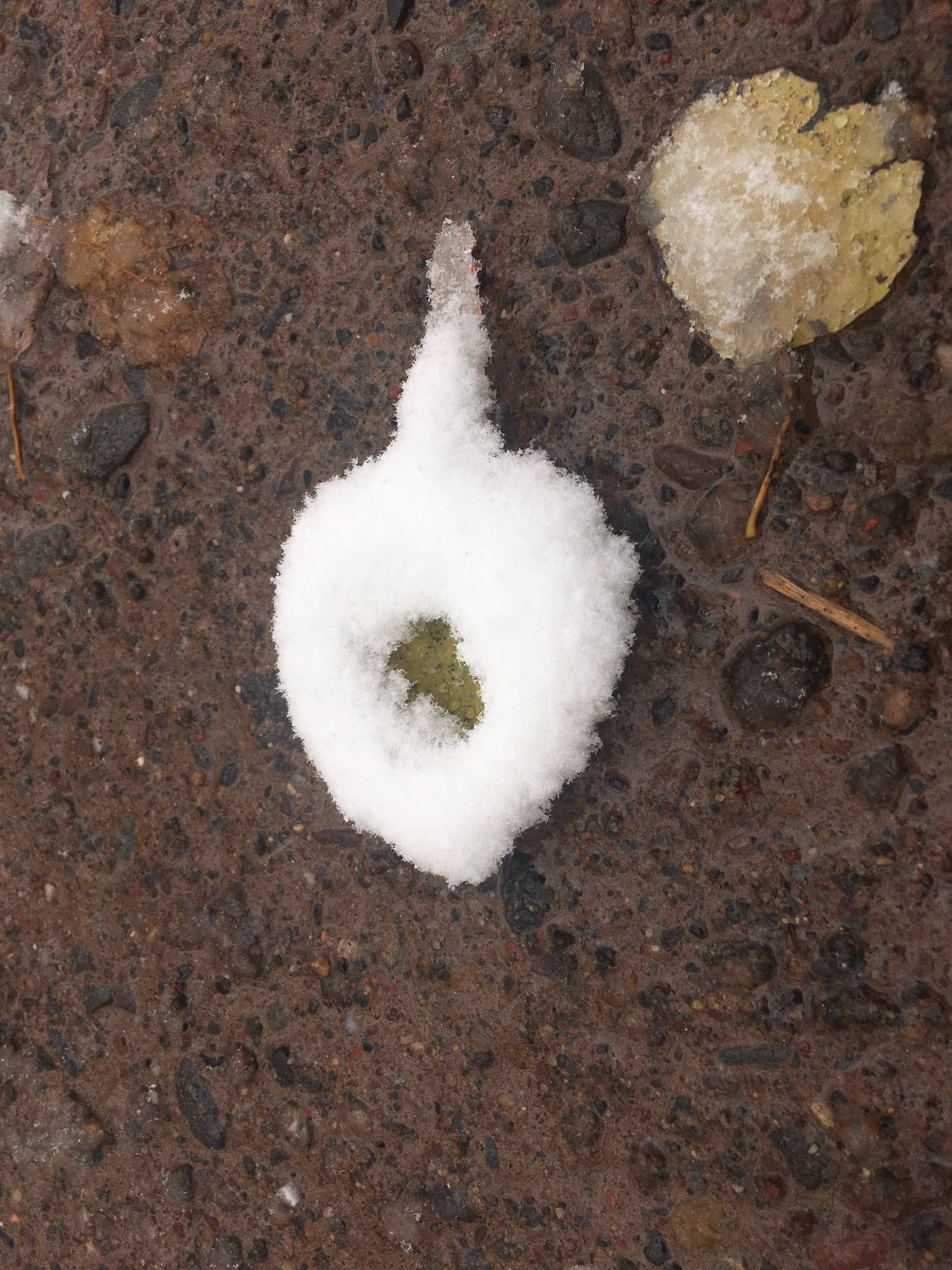
About halfway through the snowfall I went out for a walk on that road and discovered dozens of these magnificent little snow sculptures where leaves had fallen. You may identify the maples easily. How did you do with the birch and large tooth aspen? In all my comings and goings over the years, I did not recall seeing anything like it before. The conditions must have been just perfect for it, and it reminded me how often a naturalist sees things they’ve never seen before nor ever may again. I love that part of being a nature observer, but it always takes me a little by surprise. (Continued below photos.)


The Northumbria Community of the U.K. has a lovely blessing that is part of the morning liturgy in their book Celtic Daily Prayer, a prayer blessing I have loved for years and offered over many. It goes like this:

May the peace of the Lord Christ go with you wherever he may send you.

May he guide you through the wilderness, protect you through the storm.

May he bring you home rejoicing at the wonders he has shown you.

May he bring you home rejoicing once again into our (or his) doors.

The wonders God has shown me… I see them every day, large and small. I hope you do as well. They’re out there. I am grateful. 

Gitcha some outdoors.

~~ RGM, November 7 2022

Sunday, September 22, 2019

From My Nature Journal: Trees of Life


Trees of life.

One would have had to be living in a cave for the last several years to not have heard of the dangers being posed by the clearing and destruction of Amazonian rainforests. Of course, no one is currently decrying the former destruction of forests around the globe – boreal, temperate or tropical -- including most native forests in North America. It’s just that everyone on earth needs those Brazilian rainforests like never before in order to help sequester the superabundance of carbon being produced worldwide by the burning of fossil fuels. It seems those forests have become something of a poster-child, representing one of our best defenses against unrestrained climate change. Turns out they are trees of life.

I’ve been thinking a lot lately about those trees, and for one simple reason: I realize that Gail’s and my carbon footprint is larger than we’d like it to be, contributing to the growing problem in the first place. All of us should be concerned about our carbon footprints, you know. (Need some help? Check out carbonfootprint.com.) Oh, Gail and I practice a lot of the simpler creation care efforts like serious recycling, volunteering for environment care efforts, bunching our trips, shutting off lights and unnecessary appliances, limiting herbicides and pesticides, conserving water, converting to LED’s, and minimizing waste, especially plastics. (See zerowastehome.com.) But there are two major issues within our lifestyle that probably contribute more carbon harm than all our mitigation efforts combined. First, our home has an electric furnace. Before moving to Washington recently, I
did not even know that there were such things. It is a beast of an electricity user. We’re making plans to redo our home’s insulation and install both a heat pump and woodburning stove, but even still, our small home’s heating needs require a surprising amount of energy. Secondly, with three of our four children and our parental families half a continent or more away, we do a lot of traveling, and can really rack up the highway miles, our preferred method of travel.

Which brings me back to those trees. All of this has gotten us thinking a good deal about carbon offsetting as another possible mitigation. (See nativeenergy.com or terrapass.com.) Yes, it seems the ‘affluent western approach’ to the problem, but at least it is something that can be done. It’s literally, pardon the metaphor, fighting fire with fire: the best way to counter the destruction of a forest is to plant another. It won’t assuage my guilt, but I cannot live in a cold cave without a car at this season of my life, and at least it’s a start. I applaud those who can do more, but I appeal to them to let me do what I can without judging me too severely.

Trees of life. Trees impact life positively, no doubt about it, and that’s an understatement. It should surprise no one that trees play an important part in the well-being of Earth; indeed, a greater attention to creation, I believe, will produce a greater physical and spiritual well-being in the lives of individuals as well. And as for trees, nature has such a positive impact, for example, that children would simply do well to get outside and climb a few trees more often!

But as usual I’ve got something else on my mind as I continue, at least with this particular blogpost. The Bible also speaks of a Tree of Life, and that in several places. It first appears in the opening story of creation. God placed such a tree in the Garden of Eden alongside the Tree of the Knowledge of Good and Evil, and bade the man and woman leave the latter alone. Well, they didn’t, and we all know the outcome of that, an outcome that includes the abuse of creation. (My nephew by marriage posted on Facebook today that his three-year-old daughter, when reading in their children’s picture Bible, saw the apple tree and said, “Oh, yummy, apples! Yum! Apples!” And then he asked, “Should I be concerned?” Thank you, Anthony. Yes, be concerned. Be very concerned.) And whether Eden is history or allegory is not the point; the issues it addresses are still true truths. In fact, it was the very presence of the Tree of Life that caused God to banish Adam and Eve from the garden, simply to prohibit their access to it (Genesis 3:22-24). God even goes so far as to set angels with flaming swords at the ‘east entrance of the garden’ to bar the gate and keep men and women away. Say what? Apparently there was something about that Tree that God did not yet want people to know, or, more likely, that God knew people were not yet ready for. And did you notice? Curiously, God did not prohibit them eating of the Tree of Life until after they had sinned. Fascinating. It seems it was available to them beforehand, though they did not appreciate the fact.

And then, just like that, the Tree of Life seems to disappear from the Biblical narrative for a long while. What ever happened to it? One might even ask today if it’s still out there somewhere.

It is spoken of somewhat casually in the book of Proverbs, but poetically. That wily old Solomon was quite an eclectic character and used all kinds of images in putting his truisms to the pen. Four things there are likened to a ‘tree of life:’ wisdom, righteousness, fulfilled yearning, and gentleness of tongue, all good. But I don’t think Solomon is referring to the Tree of Life here at all, he’s just making poetry out of some pretty good maxims for life.

So where next? The Tree of Life doesn’t show up again literally until the very last book of the Bible. Yep, it jumps from the first book of the Christian Bible to the last, the apocalyptic literature of The Revelation of St. John the Apostle. Some kind of consummation is afoot here that involves this special Tree. Almost immediately, in 2:7, we are told that the privilege of eating of the Tree of Life will at last be given the one who stands firm for God. As John’s heavenly vision continues, he speaks of the healing properties of the very leaves of that Tree (22:2), and this not simply for individual healing, but for the ‘healing of the nations.’ Whew, how we need that healing. Again, in 22:14, John speaks of access to the Tree given only those who keep God’s commands, and lastly, a final warning is given that will again bar access to this Tree from those who alter God’s plan (22:19). It looks like some pretty heavy stuff here.

With only a brief poetic reference in between, it seems that the Bible moves from referencing this hugely significant mystery Tree in the creation narrative to stating its important place in the consummation of time. How can this be? There must be something more, and there is. There’s one more tree of life we cannot omit, one that ties creation and consummation together; in fact, it’s where I want to end my thoughts today.

Jesus’ cross is called a tree several times in the Bible, the apostles speaking of it in their preaching in the book of Acts. For example, in the midst of a sermon about the death and resurrection of Jesus that Paul preaches in a synagogue in Antioch, he says at one point, “When all things were fulfilled that were written about him, they took him down from the tree and laid him in a tomb. (13:29)” Peter speaks similarly a couple other times in Acts. But I love what Peter says in a letter he wrote that we have in our Bible as 1st Peter. He’s also speaking of Jesus there and says of him, “…who his own self bore our sins in his body on the tree, that we, having died to sin, might live to righteousness. By his stripes you were healed. (2:24)”

Jesus’ cross is the Tree of Life. It is there both for our healing and that of the world. Through Jesus, God has finally dismissed those crack guards with the light sabers and made the Tree of Life available to eat from yet again.

I guess it’s something like sin offsetting.
~~ Go plant a tree.
RGM, September 17 2019

Tuesday, April 24, 2018

From My Nature Journal -- Celebrating Earth Day by Praying through the Creation Story: Day 3, "Awed"


Introduction: The ways people pursue God, or even pray, can be as different as the very people who pursue God. Spiritual writers and mentors have long appreciated these varieties of pathways that pilgrims have followed in their prayer journey. For example, many are led to deep devotion through such things as music, contemplation or activism, but others have found that it’s the beauty and mystery of the natural, created world that leads them to a humbling encounter of praise and prayer with their Creator God. Of course, the pathways mix to varying degrees according to our personalities and interests.

Those who find nature an important spiritual pathway can see their own faith story unfold in the creation story of Genesis 1 and 2 in the Christian and Jewish Bible. Being mindful not to worship creation but only the Creator, a consideration of the natural world not only helps them do that, but also guides them in their stewardship of what God has created. Each day this week we will look to the ‘seven day’ creation story from these first two chapters of the Bible’s very first book. All references are from the Bible’s New Revised Standard Version.

Day 3 – “Awed” -- And God said, “…let the dry land appear… Let the earth put forth vegetation…” (Genesis 1:9, 11)


Reflect: OK, now we are getting somewhere, a world I can better envision! Never mind how vegetation could be created before the sun, a query that comes from too forced an admixture of our science and our theology! For now, a beautiful world comes majestically into being, forests and flowers and plains, mountains and lakes and oceans. It’s a world created for God’s good pleasure even before God gifts it to us for ours.

But what if God had stopped right here on ‘day 3’ of creation? Interestingly, the scriptures infer God’s creation still had the capacity to give God praise even without human action. From mountains that sing and trees that clap their hands in praise (Isaiah 55:12) to stones that could cry out adulation to Jesus Christ (Luke 19:40), God makes it abundantly clear that all of creation bows to him. Do I? Do you? Completely and unequivocally?

Nature is one of God’s most elemental and basic teachers, yet one overlooked by many in our sophisticated, fast-paced culture. One has to do nothing more than consider how often Jesus’ teachings and parables use examples from it. He constantly illustrates his points by speaking of such things as birds, flowers, weather, luminaries, geological features, trees, seas, fish, seasons. He knew many faith lessons could more easily be learned by people’s simple observations of God’s created order. If you have time, page through the Gospels and pick out a few. Which lesson is yours from Jesus today?

Observe: Since I cannot guarantee good spring or summer weather today everywhere this is being read, our observation will utilize the mind’s eye. Take another of those mini-retreats today and on paper begin by listing a dozen different kinds of flowers. (God’s creation is absolutely giddy with overabundance! But so are God’s other blessings!) For each of the twelve, then think back prayerfully and remember two things to list: a way God has forgiven or rescued you, and a blessing God has provided. Enjoy!

Pray: Lord, as I number my blessings, I can also become giddy with your abundance. And yet I still find there are things that hold me back from fully surrendering to you, or completely trusting you for the provision of my needs. Hear my confession. I do not wish to leave my adulation to the stones. Amen.

Hymn for the Day: “For the Beauty of the Earth”


Saturday, July 23, 2016

Blowin' in the Wind: Psalms and Calms in the Storm

("Blowin’ in the Wind" is a regular feature on my blog consisting of an assortment of nature writings – hymns, songs, excerpts, prayers, Bible readings, poems or other things – pieces I may not have written but that inspire me or give me joy. I trust they’ll do the same for you.)


Give to the Lord, you creatures of heaven,
give to the Lord all glory and power.
Give to the Lord a glorious name;
bow down to the Lord in holy splendor.

The voice of the Lord sounds over the oceans –
crashing thunder above the deep seas.
The voice of the Lord is power;
the voice of the Lord is splendor.
The voice of the Lord splits the cedars;
God splinters the cedars of Lebanon.
God makes Lebanon skip like a calf,
Mount Hermon skip like a wild young ox.

Slashing the sky with lightning-swords,
the Lord’s voice makes the desert writhe;
The desert of Kadesh quakes.
In terror, the deer flee God’s thunder,
that snaps the limbs from the trees;
in the temple, God’s glory appears.

The throne of the Lord is above sky and sea;
the Lord will rule forever.
Lord, give strength to your people;
Lord, bless your people with peace.

Psalm 29, The Psalms: A Translation for Prayer and Worship,
by Gary Chamberlain, The Upper Room


With no intent to make an illusion to the image of my “Blowin’ in the Wind” feature title, out of almost nowhere a heck of a storm just came through this afternoon. For two hours, through a dead calm, I could hear intense thunder growling from a distance, then the rain and wind pounced on us like a cat. After fifteen minutes and a half inch of rain, it was gone and quiet again.

I don’t know if storms are burlier here in this part of the Northwoods than other places where we’ve lived, or if the 100-foot hemlocks that surround our little cabin in the woods just make it seem so, dancing madly in the tempest as they do. During the mayhem I love to sit on the three-season porch and watch, almost makes me feel like Captain Dan lashed to the mast in Forrest Gump. Actually, I confess it also allows me to quickly get pans under the roof leaks that spring up out there during squalls when the wind direction is just right, leaks I can never seem to locate up top to repair. Of course, if from the roof I climbed one of our ‘cedars of Lebanon’ and weathered the gale from that vantage point, I‘d not only be one up on Captain Dan, but I’d do a nature trick John Muir pulled off from a Sequoia in the high Sierras…

Add some hail to the mix of these storms and it’s just crazy -- the trees give some shelter to the cabin, but the lake looks like it’s shaking right out of its basin, little six to twelve inch splash pillars skipping above it as far as the eye can see, which usually isn’t far in the downpour.

Perhaps peace in the storm is the image
the psalmist intended all along…

But back to Psalm 29, its metaphors and similes arrest me each time I read them. They come from the heart of someone who knew both the outdoors and his God. Wild. Unpredictable. Powerful. But Glorious! As awesome in bedlam as serenity. And that’s one of the things I love most about the Psalm, the way it ends. We’ve just been given a birds-eye view (at least a bird in a tree) of a stormy uproar showcasing the strength of God, and the psalmist is bold enough to ask not only that God would also give such strength to his people, but that God would additionally bless them with peace, a grace seemingly opposite that presented in the previous words.

Perhaps peace in the storm is the image he intended all along.

Jesus awoke and rebuked the wind, and said to the sea, “Peace! Be still!” The wind ceased, and there was a great calm. (Mark 4:39)
~~ RGM, July 9, 2016

P.S. I wrote a couple years ago on storms and their effect in producing strength and resilience in trees, and some surprised scientists who had made some hasty assumptions about weather’s influence on plants. A lesson for a different day, you might want to check it out. Click here to be taken back to that July 2014 post.